
Table of Contents
ToggleChoosing the Best Cement for House Construction is one of the smartest decisions you can make before starting your dream home. In Indian residential construction, cement is not just a binding material—it directly impacts foundation strength, slab life, crack resistance, waterproofing performance, and long-term maintenance costs. Based on current 2026 India market comparisons, brands like UltraTech, ACC, Ambuja, and Dalmia continue to lead due to consistent compressive strength, availability, and performance across residential RCC and masonry work.
From a practical construction perspective, many homeowners make the mistake of choosing cement only by brand popularity or lowest bag price. However, real performance depends on where the cement is being used—foundation, roof slab, beams, brickwork, or plastering.
In this guide, we’ll break down:
- Which cement type works best for each house stage
- how OPC, PPC, and PSC differ
- top brands in India
- price vs. durability comparison
- contractor-backed usage tips
- common buying mistakes to avoid
This approach helps you choose the best cement for home construction based on actual site needs rather than generic recommendations.
Why Cement Choice Impacts the Life of Your House
A house is only as strong as its structural core.
Even when steel and design are perfect, poor cement selection can create problems like the following:
- roof slab cracks
- seepage after monsoon
- damp internal walls
- weak plaster bonding
- reduced RCC strength
- shorter building life
From real residential construction workflows, the same cement should not be used blindly for every application.
Experienced engineers usually divide cement usage into:
- high early-strength zones
- long-term durability zones
- moisture-sensitive areas
- surface finishing work
That is why understanding cement types matters before buying in bulk.
1) OPC Cement – Best for Structural Strength
Ordinary Portland Cement (OPC) is the first choice for high-load structural components.
Best used in:
- footing
- columns
- beams
- slab casting
- lintels
Why builders prefer it :
OPC 53 grade offers high early compressive strength, making it ideal for fast RCC progress and slab work. Current expert comparisons continue to recommend OPC 53 for slab casting and load-bearing members.
Practical use :
If your house includes G+1 or duplex construction, OPC 53 is usually preferred for columns and slabs.
Portland Pozzolana Cement (PPC) is the most balanced option for Indian homes.
Best used in:
- brickwork
- internal walls
- external plaster
- masonry
- finishing works
- humid climate regions
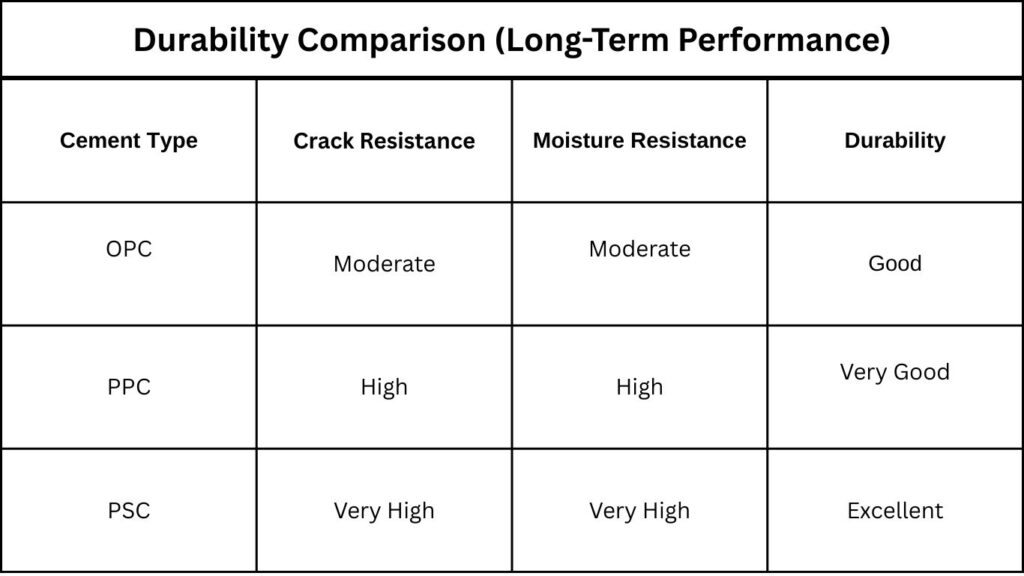
Why it performs better long-term
PPC gains strength gradually but offers the following:
- lower shrinkage cracks
- better moisture resistance
- improved finish
- lower heat generation
- better wall durability
For most Indian houses, PPC is widely recommended for better lifecycle performance.
3) PSC Cement – Best for Moisture & Aggressive Soil
A lot of homeowners ignore Portland Slag Cement (PSC), but it is excellent in the following:
- basement work
- high groundwater areas
- sulfate-prone soil
- coastal regions
- water tanks
PSC performs strongly in aggressive environments due to its chemical resistance.
Best Cement Brands for House Construction in India
UltraTech Cement – Best Overall
UltraTech remains India’s most widely trusted option for both RCC and full-house construction due to its consistent quality and distribution network.
Best for
- slab
- columns
- foundation
- full RCC homes
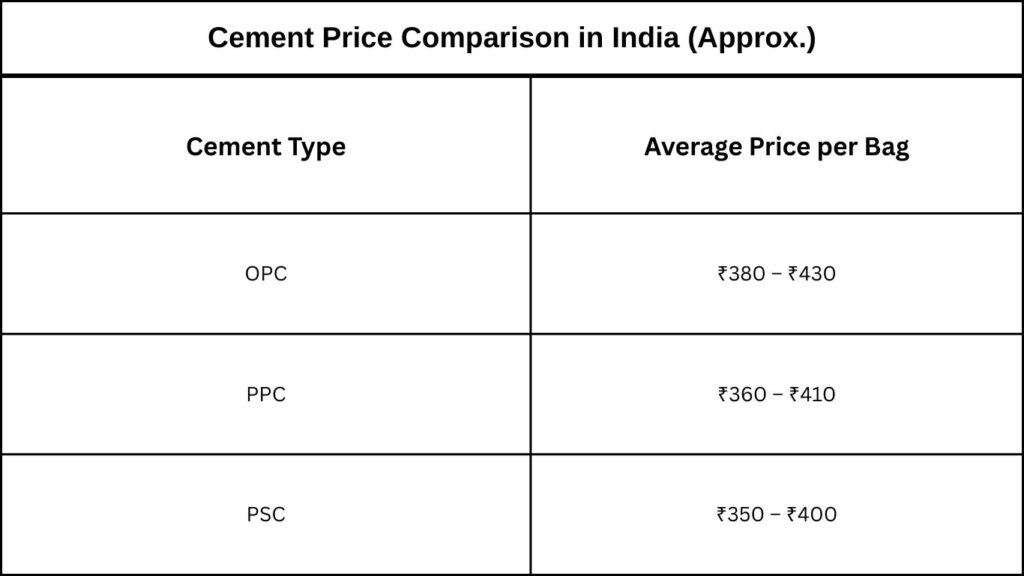
Approx price: ₹440–₹460
ACC Cement – Best for RCC Reliability
ACC is highly preferred by contractors for the following:
- predictable setting time
- strong bond
- good shuttering support
- reliable slab strength
Excellent for:
- structural frame
- footing
- beam casting
Ambuja Cement – Best for Masonry & Plaster
Ambuja performs exceptionally well in:
- smooth plaster
- wall work
- external surfaces
- crack control
Its workability makes it popular in residential finishing stages.
Cement Price vs. Performance: What Actually Matters
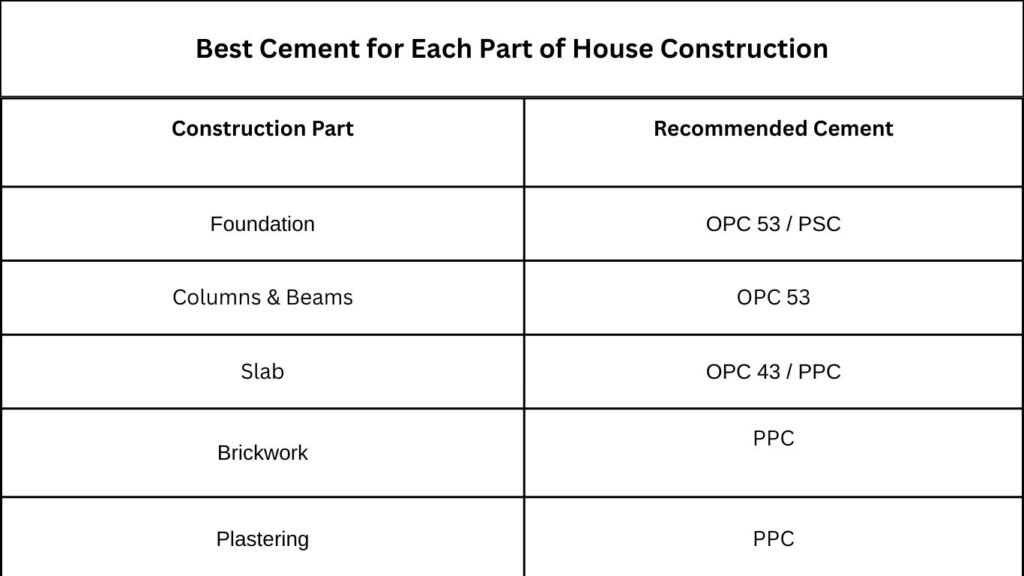
Which Cement Is Best for Each Part of the House?
This is where most blogs stay generic. Here’s the real-use breakdown.
Foundation
Best choice:
- OPC 53
- PPC in moisture-prone soil
- PSC for aggressive groundwater
Roof Slab
Best:
- UltraTech OPC 53
- ACC OPC 53
Reason:
higher early strength + fast formwork cycle
Columns & Beams
Best:
- OPC 53 only
- avoid low-grade blended cement here unless engineer-approved
Brickwork
Best:
- PPC
- Ambuja / Dalmia
Plastering
Best:
- PPC or OPC 43
- smooth texture brands
Bathroom / Terrace Waterproof Zones
Best:
- PPC / PSC
- weather-resistant variants
This stage-wise selection creates better structural performance and lower crack risk.
How to Choose the Best Cement for Your House
- Understand soil and environmental conditions
- Use different cement types for different construction stages.
- Do not choose cement only based on price.
- Follow civil engineer recommendations
Common Mistakes to Avoid While Buying Cement
- Using OPC 53 grade for plastering
- Buying cement without the ISI mark
- Improper storage leading to moisture damage
- Overusing high-grade cement unnecessarily
Expert Tips from Civil Engineers
- PPC cement is best for most residential houses.
- Always store cement in dry, covered areas.
- Cement should be used within 3 months of manufacturing.
- Proper water-cement ratio is more important than cement brand.
Conclusion
Choosing the best cement for house construction is an important choice that affects how safe, strong, and long–lasting your home will be. Good quality cement makes the structure stronger, helps it stand up better in different weather, lowers the cost of fixing things later, and lasts longer. Since every building project is different, you need to look at things like when the construction is happening, the weather, the quality of materials, and how much money you have before deciding.
Don’t just go by which brand is the most popular or what is advertised.
Instead, talk to people who know about construction and learn how the cement works in real situations. Checking the cement‘s strength, how well it lasts, and how reliable it is, especially in the weather of India, will help you pick the right one for your project. Making a smart choice now helps create a house that is safe, strong, and can last for many years.
Frequently Asked Questions
1) Which is the best cement for house construction in India?
The best cement for house construction in India depends on the stage of work. For slabs, beams, columns, and foundations, OPC 53 grade cement is the best choice because it provides high early strength. For brickwork, plastering, and long-term durability, PPC cement is widely preferred, as it offers better crack resistance and moisture protection. For most homes, builders recommend using OPC for RCC and PPC for walls and finishing.
2) Which cement is best for slabs and foundations?
The best cement for slabs and foundations is usually OPC 53 grade cement because it develops strength quickly and supports heavy structural loads. It is ideal for RCC work, footing, columns, and roof slabs, where early strength and faster shuttering removal are important.
3) How do I choose the right cement brand for my home construction?
To choose the right cement brand, consider cement freshness, consistency, climate suitability, and the specific construction stage. Always buy cement less than 30 days old, use one brand throughout the project, and consult a structural engineer rather than relying solely on dealer recommendations.